Fit Begins With Collaboration
A well-fitting restoration starts before fabrication. The dentist gathers information about the patient’s teeth and bite, then gives the laboratory clear instructions. The technician uses those records to shape a restoration, and the dental team checks it before placement. Each step matters: a flaw in the records or a missed detail can affect the final fit.
An on-site lab can make it easier for the dentist and technician to discuss a case directly, clarify specifications, and coordinate changes during fabrication. Research on dental laboratory crowns also identifies communication and accurate clinical records as factors that support restoration quality, though its findings do not show that an in-house lab alone guarantees a better fit (laboratory crown quality study).
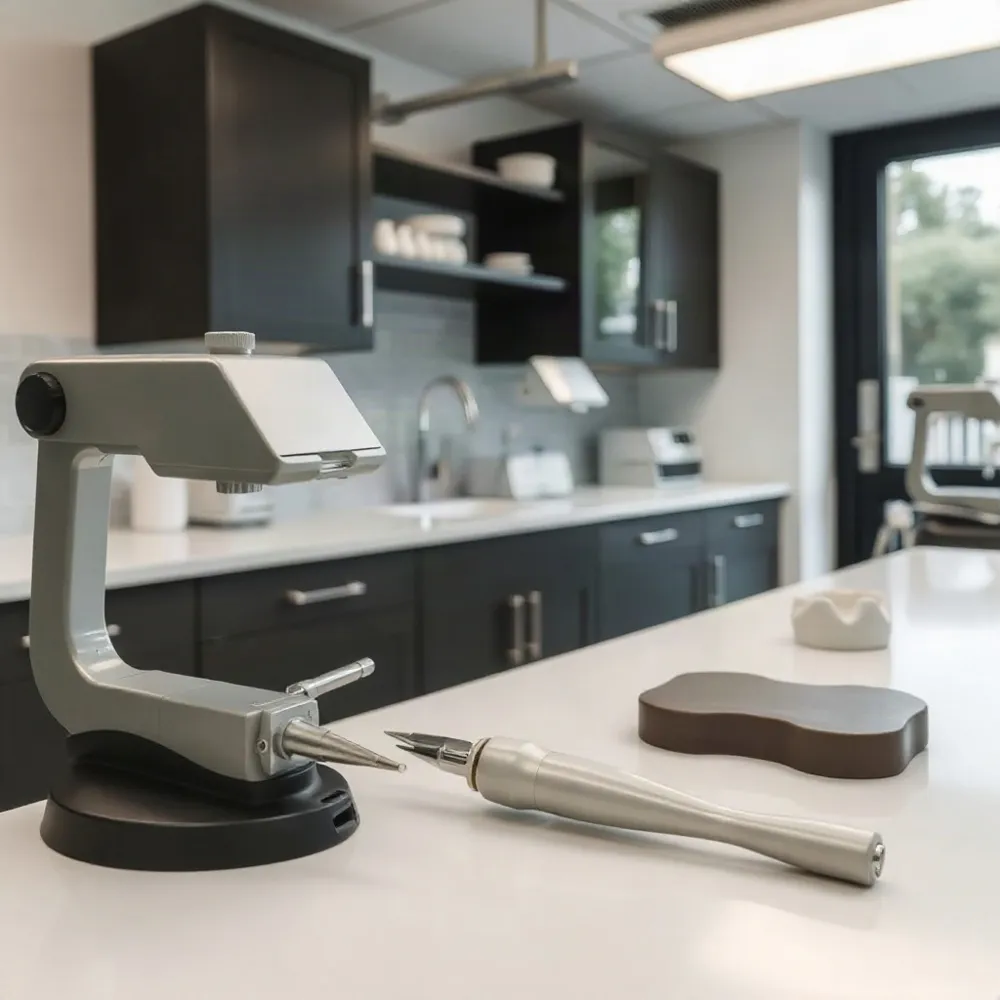
Tigani Family Dentistry is a family-owned Wilmington practice with an in-house lab. That setting brings laboratory work into the practice, where the dental team can coordinate with the lab as treatment is planned. The specific process and timing depend on the restoration and the patient’s needs.
What a Dental Laboratory Does
 A dental laboratory makes custom restorations and appliances from information supplied by a dentist. That information may include a physical impression, a digital scan, and instructions about the patient’s bite, oral anatomy, and treatment needs. Technicians use these records to create items such as crowns, bridges, and dentures.
The goal is to shape each restoration for the patient’s mouth while considering how it will function and look. A crown, for example, must fit the prepared tooth and work with the surrounding teeth. Material choice, contour, and shade can also affect the finished result. A laboratory study of porcelain-fused-to-metal crowns found variation in fit, contour, and shade across the labs tested, underscoring that records, technical work, and review all matter; the findings apply to that study sample, not every restoration or laboratory. [The laboratory accuracy study](https://pmc.ncbi.nlm.nih.gov/articles/PMC7967459/) describes these factors.
What is the purpose of a dental laboratory? It turns a dentist’s treatment plan and patient records into a restoration that can help restore oral function or appearance. The dentist evaluates the finished work, checks how it fits, and places it when appropriate. If the fit or bite needs refinement, the dentist can request adjustments before placement or address them during follow-up.
At Tigani Family Dentistry, the in-house lab supports coordination between restoration work and care in the practice. Keeping the lab on-site gives the dental team a setting for personalized treatment planning, while the dentist remains responsible for assessing the patient’s needs and the finished restoration. The specific process and suitable restoration depend on the case.
Digital Impressions and Accurate Records
 Digital impressions are computer-generated, three-dimensional images of the teeth and gums. A dental professional moves a handheld scanner over the mouth, capturing images that software combines into a model. The team can inspect the model on screen, rescan areas that need more detail, and send the file for restoration planning or fabrication.
What are digital dental impressions, and how are they taken?
Unlike conventional impressions, which use a tray and putty-like material, scanning avoids that material and allows the team to review the record immediately. Some patients find this more comfortable, particularly if impression material triggers gagging. Digital files can also be transferred electronically rather than shipped as a physical impression. Tigani Family Dentistry has an in-house lab, giving its dental team a lab setting for restorative care, though the available information does not confirm which scanning equipment or workflows are used.
What are the advantages and disadvantages of digital dental impressions compared with conventional impressions?
A 2021 laboratory study using a typodont molar found smaller measured gaps with digital impressions than with conventional impressions in that experiment. The study does not show that every digital scan will produce a better-fitting restoration in clinical practice, and its findings were limited to the tested setup (study of digital impression accuracy).
Digital scanning also has limits. Results depend on the scanner, its software, the case, and the clinician’s technique. Saliva, blood, or patient movement can affect image capture, and equipment costs and staff training are practical considerations. Conventional impressions remain an established option and may be better suited to some cases or settings. Neither method guarantees a perfect fit; accurate records and careful review matter whichever approach the dentist selects.
At Tigani Family Dentistry, the in-house lab is part of the practice’s restorative care, but the right impression method depends on the patient’s needs and the treatment planned. Ask the dental team which approach is appropriate and how the resulting records will guide fabrication.
Choosing Conventional Impression Materials
When a conventional impression is needed, the material is chosen to capture the details required for the restoration and remain stable as it is handled. Polyvinyl siloxane, often called PVS or VPS, and polyether are elastomeric materials commonly used for this purpose.
There is no single material that is best for every impression. The dentist considers the case, the amount of moisture that can be controlled, the detail needed, and the impression technique. Polyether is naturally hydrophilic, which can make it useful when moisture control is difficult, while PVS is widely used for its accuracy and dimensional stability.
So, what is the most accurate material for conventional dental impressions? PVS is a common choice for accurate, stable impressions, and polyether is another precise option. Research comparing impression methods has mixed findings, and one in-vitro study on a prepared typodont molar found smaller gaps with digital impressions than with conventional addition-silicone impressions. That result is limited to a laboratory model and does not establish a universally superior material or method in clinical care. The study of digital and conventional impressions supports the need to consider study conditions and technique when interpreting accuracy.
At Tigani Family Dentistry, the dental team has an in-house lab, which supports direct coordination around restoration records and fabrication. The dentist can assess the treatment needs and select an impression material and technique suited to the individual case.
Fit Checks Before a Crown Is Placed
 Before a crown is placed, the dentist checks whether its shape, bite, and edge suit the prepared tooth. Direct discussion between dentist and technician can clarify the design and allow feedback during fabrication. At Tigani Family Dentistry, an in-house lab gives the dental team a setting for direct coordination on restorations, though a good result also depends on accurate records and the quality of the tooth preparation.
A crown should sit securely against the prepared tooth, with its edge, or margin, meeting the tooth closely. The margin may be just above, at, or slightly below the gumline, depending on the tooth and treatment plan. The crown should feel stable and comfortable when you bite, and it should not irritate the surrounding gums.
A laboratory study assessed crowns made by 32 dental laboratories and found variation in marginal fit, contour, and contacts across its sample. The researchers emphasized the role of clear prescriptions and teamwork between dentists and technicians, but the study did not compare on-site and off-site labs or establish that one setting guarantees a better fit. The laboratory-quality study offers a reminder that the whole process, from clinical records to fabrication, matters.
If you notice a gap at the crown’s edge, looseness, persistent pain or sensitivity, or red, swollen, or bleeding gums, contact your dentist for an examination. These signs can have different causes, including gum recession or decay, and do not by themselves show that the crown is defective. An exam can determine whether the crown, tooth, or gums need attention.
When a Crown or Impression Needs Care
A traditional impression can dislodge a crown, but this is uncommon. The risk may be greater if the crown is already loose or its cement seal has weakened, since impression material can catch around it as the tray is removed. Before taking an impression, the dental team can check the crown’s stability and use care when removing the tray.
Can taking a dental impression dislodge a crown?
Yes, it is possible, though not typical. Digital scanning records the teeth without impression material or a tray, and clinicians can review the scan on screen; it still takes clinical judgment to choose the right method and assess the tooth. Research comparing digital and conventional impressions describes scanning as an alternative, but does not establish that it prevents crown problems in every case (digital impression study. Tigani Family Dentistry has an in-house lab, where the dental team can coordinate restorative care.
If a crown comes off, keep it safe and contact your dentist promptly for instructions. Do not try to glue it back yourself. The dentist can assess the tooth and advise whether the crown can be reused or needs other care.
Lab Timing and Treatment Costs
How long does it take a dental laboratory to make a crown?
With an outside laboratory, the usual sequence is tooth preparation, placement of a temporary crown, fabrication of the permanent crown, and a return visit for fitting and cementing. The full process commonly takes about two to three weeks, though timing depends on the restoration, the lab’s workload, and whether adjustments are needed.
Some dental offices can make certain crowns in-house in one visit, which may reduce the time spent wearing a temporary. Tigani Family Dentistry has an in-house lab, allowing the dental team to coordinate restoration work on-site. That does not mean every crown can be completed in one visit; suitability and timing depend on the case.
How much do digital dental impressions typically cost?
Digital impressions generally do not have a separate standard patient price. They are usually part of the overall procedure, and charges depend on the office and treatment, such as a crown or bridge. Insurance benefits vary by plan, so ask for an estimate and check how your PPO coverage applies. Tigani Family Dentistry accepts most PPO insurance plans, and its team can explain expected costs before treatment.
A shorter workflow can make treatment more convenient and reduce the time spent with a temporary restoration, but it is not the right option for every case. The dentist can explain the expected schedule, whether an in-house crown is suitable, and any costs before care begins.
A Better Fit Takes a Team
A well-fitting restoration depends on more than where it is made. An on-site lab can help a dentist and technician review details together, while accurate records, suitable materials, clinical skill, and quality checks remain essential. Tigani Family Dentistry has an in-house lab, bringing fabrication into the practice’s care setting, but no lab arrangement guarantees a particular result or timeline.
Ask your dentist which impression and fabrication workflow suits your treatment, how the restoration will be checked, and whether adjustments may be needed. Clear answers can help you understand the process and make informed decisions about your care.