Why Speed Matters in Modern Dentistry
Patients today expect dental work to be completed quickly—often within a single visit or a few days—especially when a wedding, job interview, or vacation is approaching. Long wait times create discomfort, aesthetic anxiety, and can jeopardize treatment plans. Modern technology eliminates those delays. Digital intra‑oral scanners transmit precise 3‑D data instantly to an on‑site CAD/CAM system, allowing technicians to mill crowns, bridges, or dentures in 30‑45 minutes and finish them with 3‑D printing or sintering. Integrated practice‑management software automates case submission, approval, and billing, further shrinking administrative lag. An in‑house laboratory harnesses these tools to deliver same‑day or next‑day restorations, cutting traditional 10‑14‑day shipping cycles to 2‑3 days. Because the dentist and technician work side‑by‑side, real‑time shade matching, design tweaks, and quality‑control checks prevent errors and remakes. Direct oversight also enables the use of premium materials such as zirconia and lithium disilicate, enhancing durability and aesthetics. Fewer appointments, reduced shipping costs, and faster turnaround improve patient satisfaction, lower overall expenses, and reinforce the practice’s reputation for efficient, patient‑focused care. By meeting these rapid‑service expectations, practices not only boost loyalty but also attract new patients who value convenience and high‑quality results, creating a competitive advantage in today’s fast‑paced dental market.
Real‑Time Collaboration Cuts Turnaround from Days to Hours
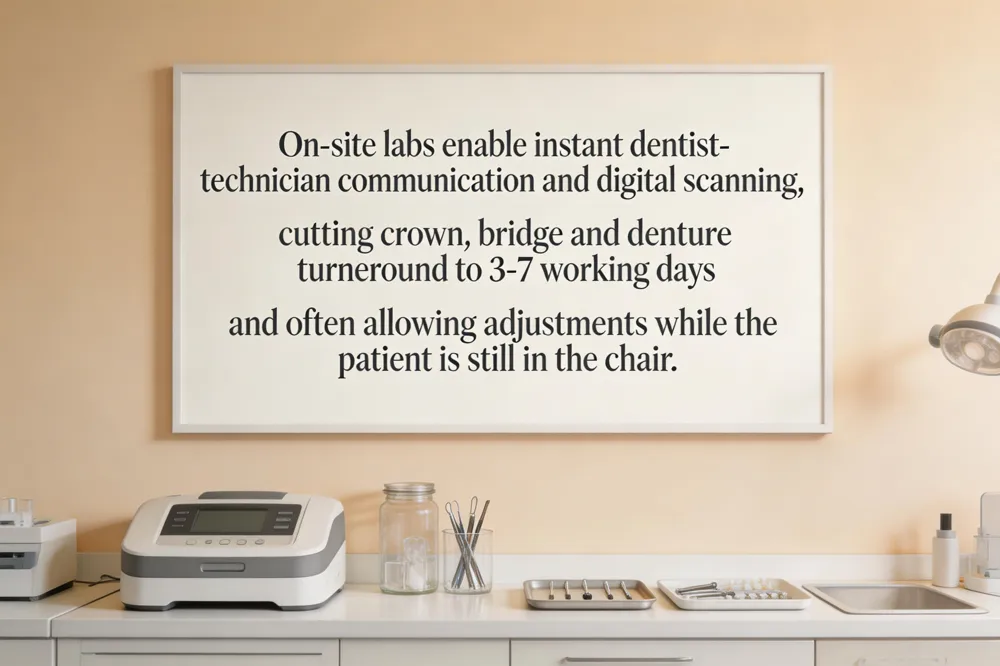 In practices‑house pocket labs the dentist and the technician share the same space, allowing instant, face‑to‑face communication. When a shade, fit or design question arises, the clinician can discuss it on the spot, eliminating the lag of phone calls or emails that typically cause errors and remakes. Coupled with digital intra‑oral scanners, the impression is captured and transmitted to the lab in seconds, so the technician can begin CAD design and CAM milling immediately. This seamless data flow means that case‑by‑case revisions are reduced dramatically—most adjustments are made while the patient is still in the chair, and only a fraction of cases need a second visit for tweaks.
Typical turnaround time: With an on‑site laboratory, most fixed restorations—full‑cast, zirconia, or porcelain‑fused‑to‑metal crowns—are usually ready in 3–5 working days. Removable prosthetics follow a similarly quick schedule: digital dentures take 5–7 days, while an immediate denture can be completed in about 10 days. Simple adjuncts like bite rims, custom trays, and temporary crowns often finish within 2–3 days, and a partial design or estimate is typically delivered in 3 days. Because the lab is in the same office, the practice can design, mill, and finish the restoration without the extra shipping time required by external labs, cutting overall turnaround by several days and boosting patient satisfaction.
Quality Control and Customization Under One Roof
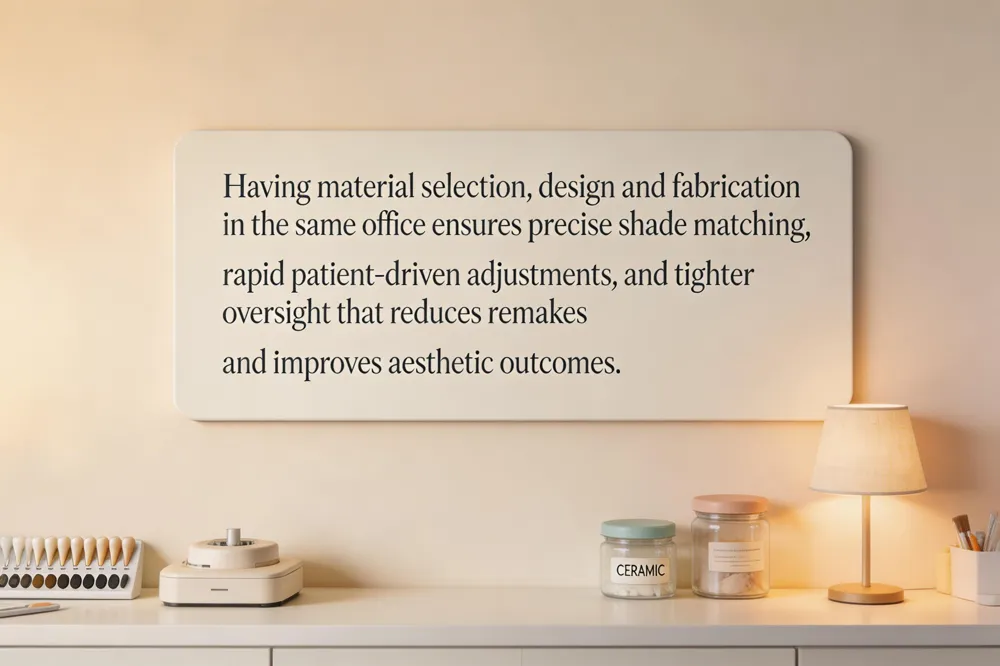 In a family‑focused clinic such as Tigani Family Dentistry, the on‑site laboratory serves as the engine that drives precise, personalized care. By keeping material selection and fabrication under the same roof, the practice maintains tighter oversight of every step—from choosing high‑strength zirconia or translucent lithium disilicate to the final polishing of crowns, bridges, and dentures. This direct supervision ensures that each restoration meets rigorous durability and aesthetic standards, reducing the risk of remakes.
Patient‑driven shade matching and design adjustments become a real‑time dialogue. As the dentist takes a digital impression, the technician can instantly modify hue, translucency, or contour based on the patient’s feedback, allowing the final prosthesis to blend seamlessly with natural teeth. The seamless collaboration shortens the appointment chain and enhances satisfaction, especially for busy families.
What role does a dental laboratory play in a family‑focused dental clinic? The lab creates custom restorations—crowns, bridges, dentures, aligners, and implant components—that match each family member’s unique anatomy and aesthetic preferences. Working hand‑in‑hand with dentists, it ensures precise fit and natural appearance, reduces extra visits, and expands the range of personalized services, from restorative work to cosmetic treatments like Botox, supporting Tigani’s commitment to comfortable, efficient, family‑centered care.
What is the 3×3 rule for dental implants? It is a guideline requiring at least 3 mm of bone height above the implant platform and 3 mm of bone thickness around the implant on all sides, ensuring primary stability and successful osseointegration. If the site falls short, bone grafting is recommended before placement.
Financial Efficiency: Lab Fees, Insurance, and In‑House Plans
 Lab fees usually represent about 5 % of a dental practice’s gross revenue, with most offices falling between 4 % and 6 % of total collections. Practices that outsource the majority of crowns, bridges, and orthodontic appliances tend toward the upper end of that range, while those that fabricate many restorations in‑house with CAD/CAM technology can keep fees near the lower end.
In‑house dental plans can be a smart financial choice for patients who receive most of their care at a single practice such as Tigani Family Dentistry. These plans often provide lower out‑of‑pocket costs than traditional PPO insurance because they eliminate claim forms, waiting periods, and annual benefit caps. The discounted rates apply immediately to routine cleanings, exams, and many cosmetic or restorative procedures, offering predictable savings when a family stays with the practice for all dental needs.
By controlling the entire fabrication process, an in‑house lab reduces external shipping fees and third‑party markup, which helps keep overall treatment costs down. The practice can also streamline insurance handling, as many procedures are completed in a single visit, reducing billing cycles and improving cash flow. Consequently, patients benefit from faster, more affordable care while the practice maintains healthy profit margins.
Leadership and Expertise Behind the Lab
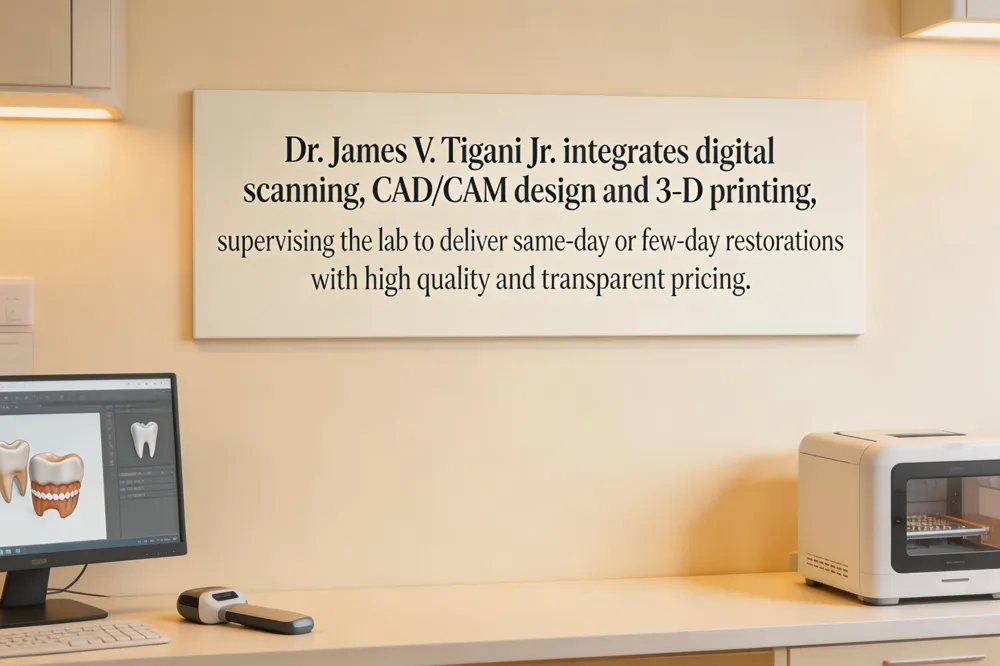 Dr. James V. Tigani Jr., DDS, is the second‑generation clinician who leads Tigani Family Dentistry in Wilmington, DE. As the son of founder Dr. James V. Tigani III, he upholds the practice’s legacy of comprehensive, patient‑centered care while overseeing both clinical and laboratory operations. Dr. Tigani Jr. coordinates the seamless integration of digital intra‑oral scanning, CAD/CAM design, and on‑site 3‑D printing, allowing the in‑house lab to produce crowns, bridges, veneers, and orthodontic appliances within the same appointment or a few days. This close collaboration eliminates shipping delays, enables real‑time shade‑matching and design adjustments, and ensures rigorous quality control under his direct supervision. His commitment to a family‑focused philosophy means every patient experiences a comfortable, personalized environment, with fewer visits, faster turn‑around, and transparent PPO‑compatible pricing. By aligning clinical expertise with laboratory precision, Dr. Tigani Jr. guarantees that each restoration meets the highest aesthetic and functional standards while maintaining the practice’s reputation for efficient, compassionate dental care.
Practice Management Principles That Drive Speed
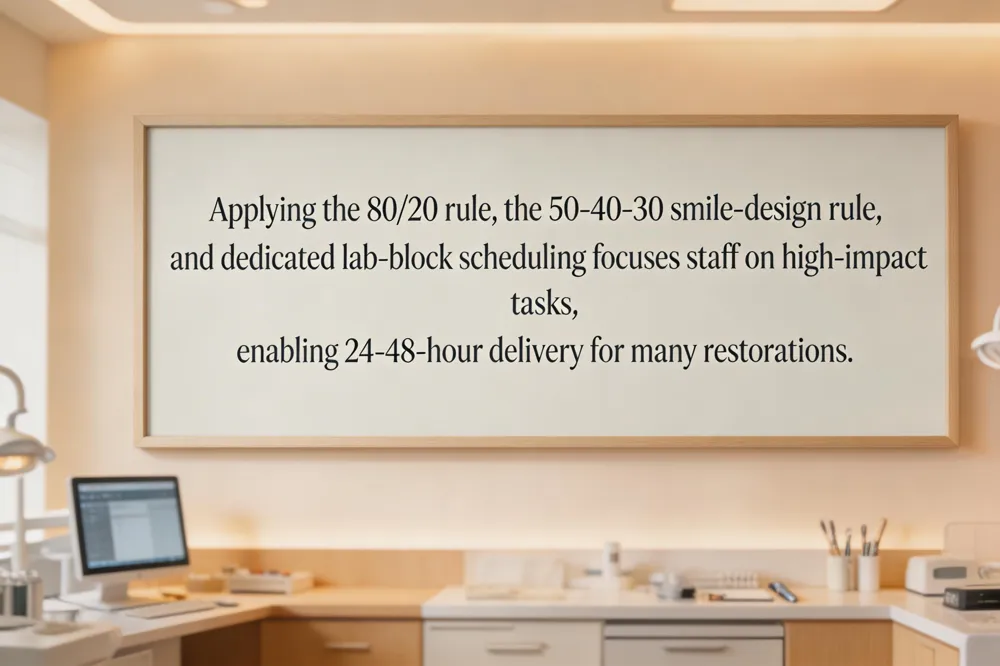 Effective practice management is the backbone of fast, high‑quality dental care, especially when an in‑house laboratory is part of the workflow.
The 80/20 rule in dentistry – also known as the Pareto principle – states that roughly 80 % of revenue and patient satisfaction stems from only 20 % of activities. In a practice with an on‑site lab, those high‑impact tasks include rapid digital scanning, real‑time shade matching, and immediate technician feedback. By concentrating staff training, equipment investment, and scheduling slots on these core processes, the practice maximizes both profitability and patient happiness while minimizing wasted time.
The 50‑40‑30 smile‑design rule provides a clear, visual target for aesthetic restorations: central incisors should occupy about 50 % of the visible tooth width, the central‑to‑lateral incisor contact about 40 %, and the lateral‑incisor‑to‑canine contact about 30 %. When the lab sits beside the dentist, technicians can adjust contours and shades on the spot, ensuring the final restoration meets this proportion instantly and eliminating the back‑and‑forth revisions that delay treatment.
Scheduling and buffer strategies for lab work are essential to keep the fast‑track promise alive. Practices typically allocate a dedicated “lab block” each morning, allowing technicians to begin milling or 3‑D printing as soon as impressions are captured. A built‑in 1‑2‑day buffer accounts for unexpected material shortages or complex cases, while still delivering crowns, veneers, or dentures within 24‑48 hours. This coordinated schedule reduces patient appointments, cuts shipping time, and leverages the in‑house lab’s ability to make same‑day adjustments, ultimately driving higher patient satisfaction and practice efficiency.
The Bottom Line: Faster, Higher‑Quality Care with an In‑House Lab
In‑house dental laboratories transform the restorative workflow by eliminating shipping delays and enabling digital, CAD/CAM‑driven production. Practices such as Tigani Family Dentistry in Wilmington, DE, can move a crown, bridge or denture from impression to final placement in as little as a few hours to two days, compared with the typical 10‑14 days for external labs. This speed does not sacrifice quality; on‑site technicians maintain strict quality‑control checkpoints, use premium materials like zirconia and lithium disilicate, and perform real‑time shade‑matching and fit adjustments under the dentist’s direct supervision. The result is a restoration that fits precisely the looks natural the and lasts longer.
Patients experience fewer appointments, reduced waiting anxiety, and immediate relief from temporary restorations. The collaborative environment ensures that patient preferences—shade, shape, and comfort—are incorporated instantly, leading to higher satisfaction and loyalty.
If you value a seamless, rapid, and personalized dental experience, schedule a visit with Dr. Kristin Tigani‑Taylor at Tigani Family Dentistry. Discover how their on‑site lab delivers same‑day provisional crowns, next‑day definitive restorations, and a stress‑free treatment journey tailored to your smile.