A New Era in Tooth Straightening
Over the past decade clear aligners have moved from a niche option to the dominant orthodontic choice in the United States. The global market grew from $2.41 billion in 2020 to a projected $10.04 billion by 2028, and more than 10 million Americans have been treated with systems such as Invisalign, the #1 doctor‑recommended brand. Patient‑driven demand fuels this surge: adults and teens alike value the virtually invisible, removable trays that allow normal eating, oral hygiene, and confidence on video calls. Social media, insurance coverage for up to $3,000, and flexible financing further lower barriers. Technological leaps underpin the trend: intra‑oral scanners and 3‑D CAD/CAM design replace messy impressions, SmartTrack™ material delivers consistent force, and attachments plus AI‑enhanced treatment planning enable complex movements that once required metal braces. Together, these factors create a perfect storm, making clear aligner therapy the preferred, patient‑centric solution for mild‑to‑moderate malocclusions.
Understanding Clear Aligners: Technology and Treatment Options
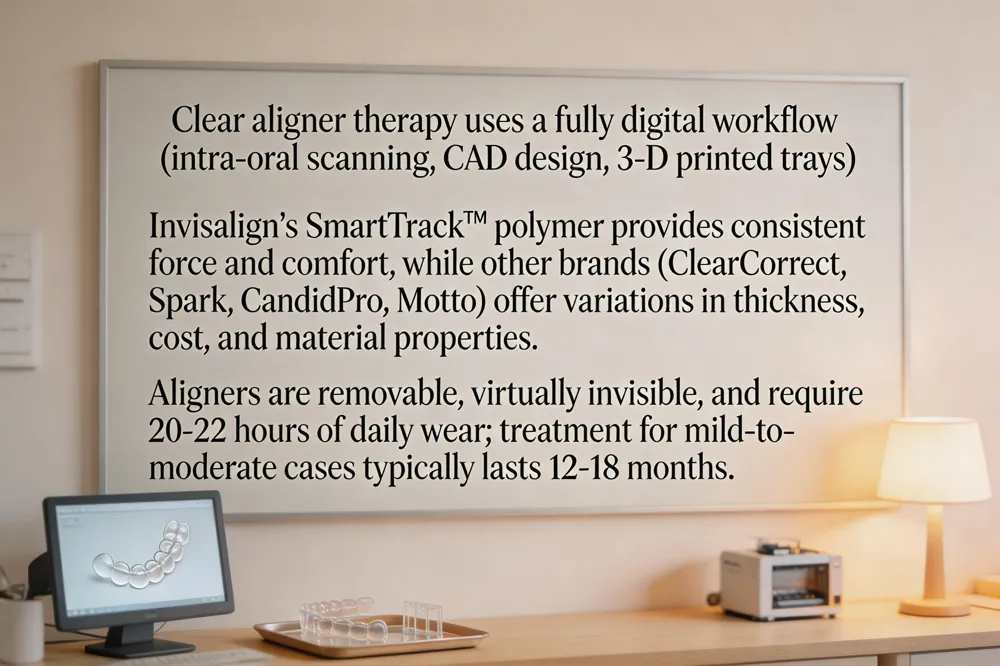 Clear aligner therapy relies on a fully digital workflow: an intra‑oral scanner captures a 3‑D model, computer‑aided design plans incremental tooth movements, and the final series of trays is fabricated from medical‑grade, BPA‑free thermoplastic. The most widely used material is Invisalign’s SmartTrack™ polymer, which delivers a softer, more consistent force and greater comfort than older single‑layer plastics. Other notable brands include ClearCorrect (thin trays, slightly lower cost), Spark (TruGEN™ material with high stain resistance), CandidPro (doctor‑directed with remote monitoring), and Motto (affordable, in‑house lab option). All of these are clear aligners, but Invisalign stands out for its proprietary SmartForce attachments and extensive digital planning that can handle complex rotations and mild to moderate extractions.
Clear aligner therapy vs. Invisalign – “Clear aligner therapy” describes any removable, transparent tray system; Invisalign is a specific, FDA‑cleared brand that uses SmartTrack™ and ClinCheck® software, allowing a broader case range.
Aligners vs. braces – Aligners are virtually invisible, removable for meals, and simplify oral hygiene, yet they demand 20‑22 hours of daily wear. Fixed braces (metal, ceramic, lingual) are always active, treat severe malocclusions without reliance on patient compliance, but they are more visible, restrict diet, and often need more office visits.
Speed of treatment – For mild‑to‑moderate cases, aligners typically complete in 12‑18 months with trays changed every 1‑2 weeks, whereas braces may take 18‑24 months for comparable issues. Complex cases may still be faster with braces, emphasizing that overall duration hinges on case complexity and patient adherence.
Clinical Effectiveness and Limitations
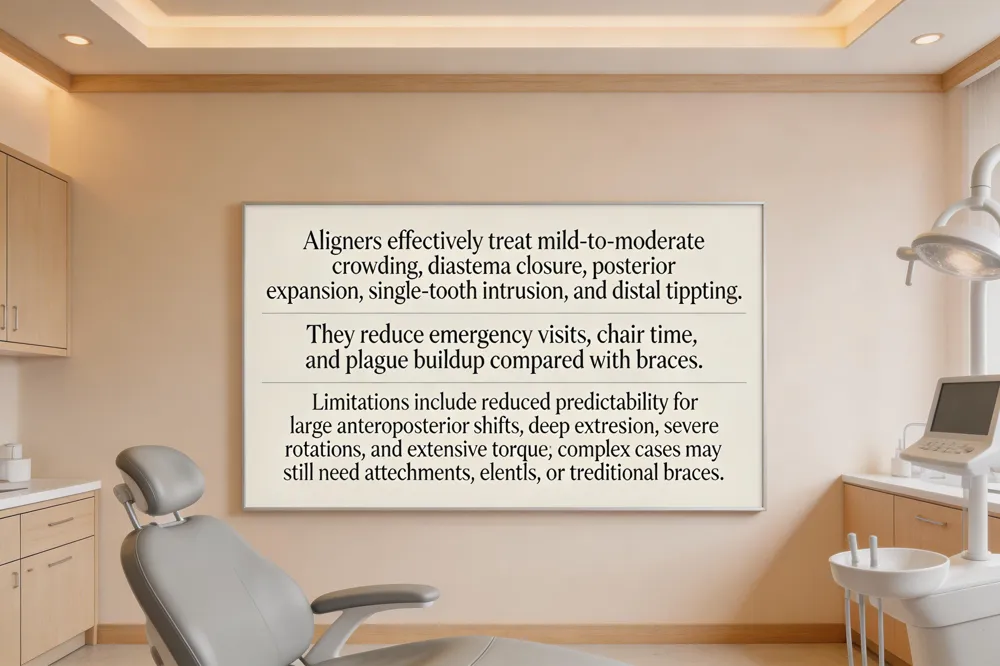 Clear aligners excel at moving teeth for mild‑to‑moderate problems such as crowding, diastema closure, posterior expansion, single‑tooth intrusion, and distal tipping of molars. Rotations of a single tooth, small bite corrections, and modest over‑ or under‑bites are also well suited, especially when attachments or elastics are used. Clinical studies show comparable space‑closure and marginal ridge alignment to fixed appliances, but aligners are less predictive for large anteroposterior shifts, deep extrusion, or extensive torque; severe rotations, molar uprighting, and large extraction‑space closures often need auxiliaries or traditional braces.
Compared with fixed braces, aligners reduce emergency visits, chair time, and plaque accumulation, leading to lower gingival inflammation, and fewer white‑spot lesions. However, they require strict patient compliance (20‑22 h/day) and can still cause root resorption, albeit at a lower prevalence than braces. Relapse rates are similar when appropriate retainers (e.g., Vivera™) are used, but long‑term stability data remain limited.
Clear aligners before and after – Crowded or gapped smiles become straight and harmonious; changes appear within 6‑12 months and retainers lock the result.
Can clear aligners fix a snaggle tooth? – Yes, for mild‑to‑moderate mis‑alignment; severe rotations may need attachments or braces.
Do clear aligners work for overbite? – Effective for mild‑to‑moderate cases with possible attachments or elastics; severe skeletal overbites may need other appliances.
Why do dentists not recommend Invisalign? – When cases exceed its capabilities—severe crowding, complex bite problems, heavy rotations, active gum disease, poor hygiene, or low compliance.
Clear aligner therapy book – Clear Aligner Technique offers a comprehensive, evidence‑based guide for diagnosis, digital planning, biomechanics, attachment design, and retention.
Patient Experience: Comfort, Compliance, and Oral Health
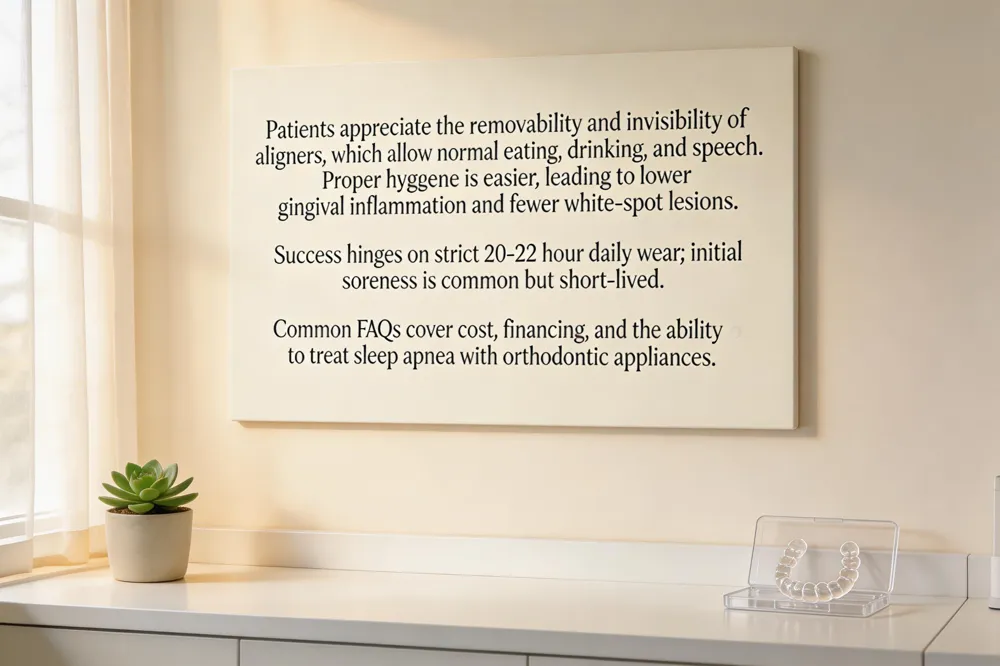 Clear aligner therapy fits easily into daily life because the trays are removable and invisible. Patients are instructed to wear each set for 20‑22 hours per day, typically changing to a new aligner every 10‑15 days; this schedule allows normal eating, drinking (water only while the aligner is in), and unrestricted speech, making the treatment virtually unnoticeable in social and professional settings. Oral hygiene benefits are substantial—because aligners are removed for brushing and flossing, plaque buildup is reduced, gingival inflammation drops, and the incidence of white‑spot lesions is lower than with fixed braces. Common concerns include the need for strict compliance, mild initial soreness, and the fear of losing trays; clinicians mitigate these by providing clear wear‑time instructions, using comfortable SmartTrack™ or TruGEN™ materials, and offering attachments or auxiliaries when complex movements are required.
Q: Can orthodontists help with sleep apnea?
A: Yes. Orthodontists can fabricate mandibular advancement devices, tongue‑retaining appliances, or palatal expanders that reposition the jaw or tongue to keep the airway open, offering a non‑invasive alternative or supplement to CPAP for mild‑to‑moderate obstructive sleep apnea.
Q: Clear aligners cost?
A: In the United States, clear aligners typically cost $1,800–$8,100, averaging $5,100; Invisalign averages about $6,000, while budget‑friendly options like Motto™ are around $3,000. Insurance and financing can lower out‑of‑pocket expenses.
Q: Invisible braces for adults cost?
A: Adult invisible braces such as Invisalign generally range from $3,500 to $9,500, averaging $5,700; simpler cases may qualify for Express® at $1,800–$3,000. Insurance and financing plans make treatment more affordable.
Q: Can you pay $100 a month for braces?
A: Many orthodontic offices, including Tigani Family Dentistry, offer payment plans that can bring monthly costs to about $100, especially for traditional metal braces, after a down payment and insurance contributions.
Q: Clear aligners near me?
A: If you’re in Wilmington, DE, Tigani Family Dentistry offers discreet Invisalign® treatment with in‑house lab fabrication, fewer office visits, and most PPO insurance acceptance.
Q: Tigani dentist?
A: Tigani Family Dentistry is a family‑owned practice in Wilmington, DE, founded in 1975. Led by Dr. Robert Tigani DDS, the office provides preventive, cosmetic, restorative, orthodontic, and sleep‑medicine services, using an in‑house lab and accepting most PPO insurances.
Financing, Insurance, and Accessibility
 Cost structures and coverage
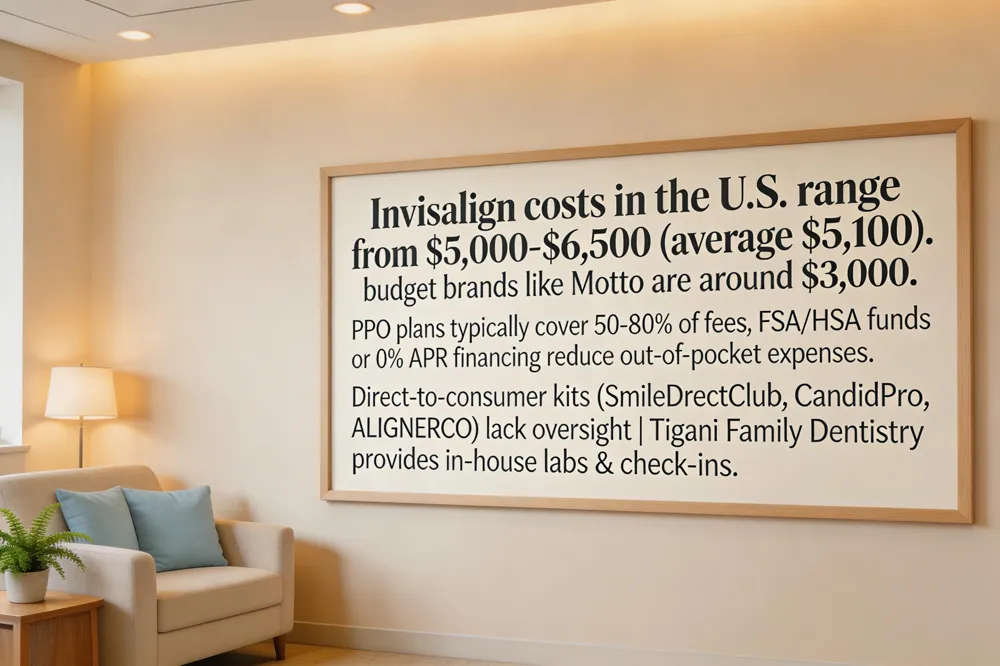
In the United States, full‑mouth Invisalign typically ranges from $5,000 to $6,500 with $5,000 considered an average price and $6,000 falling within the normal range for more complex cases. Most PPO dental plans cover 50‑80 % of orthodontic fees, often up to $3,000, and patients can also use FSA/HSA funds or financing plans (e.g., 0 % APR for 12‑24 months).
Direct‑to‑consumer vs in‑office models
At‑home kits such as SmileDirectClub, CandidPro and ALIGNERCO allow patients to start treatment with virtual supervision. While convenient and lower‑cost, they lack the hands‑on oversight of a practice like Tigani Family Dentistry, which provides in‑office check‑ins, an in‑house lab, and the ability to place attachments or auxiliaries for complex movements.
Financing options
Practices often partner with financing companies (OrthoFi, CareCredit) to offer monthly payment plans. ALIGNERCO also advertises 0 % APR financing, but treatment timelines may be longer. CandidPro offers remote monitoring plus optional in‑office visits, blending affordability with professional guidance.
Smile Direct Club
SmileDirectClub offered at‑home clear‑aligner kits with virtual supervision, but filed for Chapter 11 bankruptcy in 2023; its assets were acquired by SmileSet. The model lacks the hands‑on oversight that a practice like Tigani Family Dentistry provides.
Candid aligners
CandidPro provides doctor‑directed clear‑aligner therapy with remote monitoring. Tigani Family Dentistry partners with CandidPro, offering in‑office check‑ins and an in‑house lab for rapid fabrication.
ALIGNERCO
ALIGNERCO supplies affordable at‑home aligner kits with financing options and 0 % APR plans. While convenient, it may require longer treatment times and less professional oversight compared with in‑office care.
ALIGNERCO reviews
ALIGNERCO receives mixed feedback: users appreciate low cost and remote convenience, but some report longer timelines and variable aligner quality. Complex cases are better managed by a supervised orthodontist.
Is $6000 normal for Invisalign?
Yes. $6,000 falls within the normal range for Invisalign in the U.S., especially for complex cases or practices with higher fees. Insurance and financing can reduce the out‑of‑pocket amount.
Is $5000 a lot for Invisalign?
$5,000 is a reasonable, average cost for a full‑mouth Invisalign treatment. Insurance often covers 50‑80 % of the fee, making the final out‑of‑pocket cost lower for most patients.
Orthodontic Care at Tigani Family Dentistry
 Tigani Orthodontics
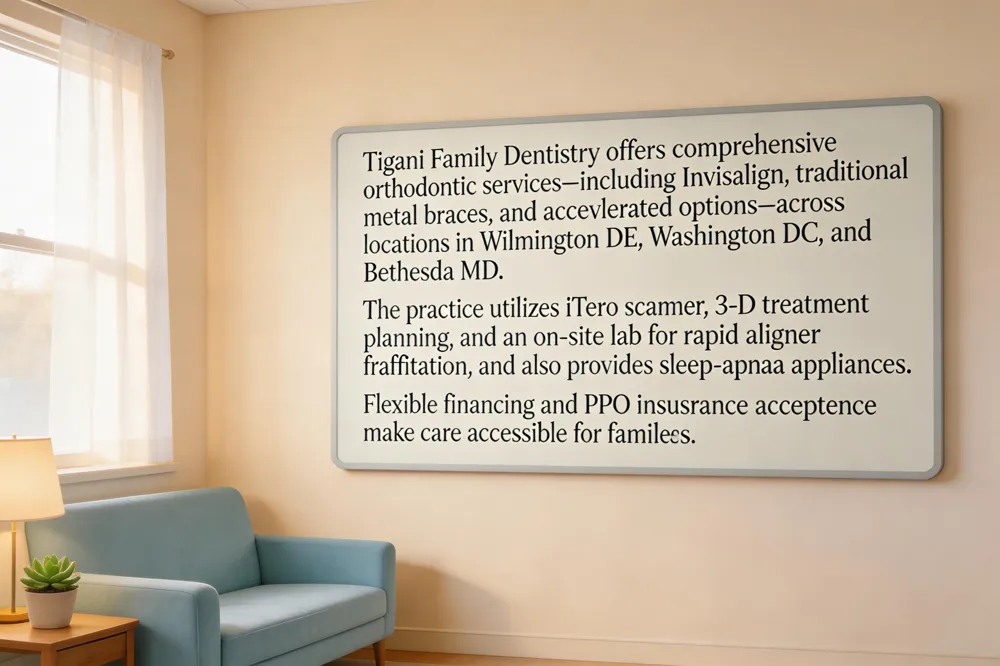
, part of Tigani Family Dentistry, delivers comprehensive orthodontic solutions—including Invisalign®, traditional metal braces, and accelerated orthodontics—through multiple locations in Washington, DC, Bethesda MD, and Wilmington, DE. Led by Dr. Stephen P. Tigani, the practice emphasizes personalized, family‑focused care with a strong commitment to technology and comfort.
Tigani Orthodontics
Tigani Orthodontics, part of Tigani Family Dentistry, delivers comprehensive orthodontic solutions—including Invisalign®, traditional metal braces, and accelerated orthodontics—through multiple locations in Washington, DC, Bethesda MD, and Wilmington, DE. Led by Dr. Stephen P. Tigani, the practice emphasizes personalized, family‑focused care with a strong commitment to technology and comfort.
Can orthodontists help with sleep apnea? Yes. Orthodontists can fabricate mandibular advancement devices, tongue‑retaining appliances, and palatal expanders that improve airway patency, offering a non‑invasive option for mild‑to‑moderate obstructive sleep apnea. Tigani’s in‑house lab and digital imaging enable precise, custom‑fabricated appliances.
Orthodontist Wilmington DE In Wilmington, Tigani Family Dentistry provides orthodontic services using iTero digital scanners, 3‑D treatment planning, and an on‑site laboratory for rapid aligner production. Patients benefit from fewer emergency visits, removable aligners for easy oral hygiene, and flexible financing.
Orthodontist Newark DE Nearby Newark options include Delaware Orthodontics, Honig Orthodontics, and GN Orthodontics, all offering Invisalign and traditional braces with modern digital workflows.
Tigani Family Dentistry reviews Online ratings for Dr. Kristin Tigani‑Taylor on Healthgrades are 5‑star, with patients highlighting a comfortable, family‑focused environment and high‑quality outcomes.
James Tigani Wilmington DE Dr. James V. Tigani IV, DDS, co‑owner of Tigani Family Dentistry, earned his DDS from the University of Maryland and provides comprehensive dental and orthodontic care in Wilmington.
Dr. Tigani DC Dr. Robert J. Tigani, DDS, operates the Washington, DC office, offering preventive, cosmetic, restorative, orthodontic, and aesthetic services supported by an in‑house lab and advanced imaging technology.
The Future Is Clear and Comfortable
Invisible orthodontics is on a rapid upward trajectory. Global market projections show a CAGR of nearly 20 % through 2028, driven by adult demand for discreet, removable solutions and by advances such as SmartTrack® polymers, AI‑enhanced treatment planning, and 3‑D printing that shorten turnaround times. Clinics are shifting toward a patient‑centric care model: digital scans replace messy impressions, virtual check‑ins reduce office visits, and in‑house labs—like those at Tigani Family Dentistry and Rawlins Orthodontics—enable faster, more personalized aligner fabrication. For patients, success hinges on choosing a provider who combines board‑certified expertise, a robust digital workflow, and transparent communication about wear schedules, attachments, and retention. Look for Invisalign® Top Provider status, a proven track record of case outcomes, and flexible financing or insurance coordination to ensure the treatment is both clinically effective and financially accessible.