Understanding Sleep Apnea and Treatment Options
Obstructive sleep apnea (OSA) affects roughly 22 million adults in the United States—about 10 % of women and 25 % of men—making it one of the most common sleep‑related disorders. The hallmark signs include loud, chronic snoring, witnessed breathing pauses, choking or gasping awakenings, excessive daytime sleepiness, morning headaches, and mood changes. Diagnosis is confirmed with a sleep study, either an overnight polysomnography in a laboratory or a home‑based sleep test that records breathing patterns, oxygen saturation, and brain activity.
Untreated OSA carries a heavy burden: intermittent hypoxia and fragmented sleep raise the risk of hypertension, myocardial infarction, stroke, type 2 diabetes, motor‑vehicle crashes, and reduced work performance. These health risks translate into substantial economic costs from medical care and lost productivity. Because the airway collapses repeatedly during sleep, patients often experience poor sleep quality, daytime fatigue, and impaired concentration, which can diminish overall quality of life and strain personal relationships. Early recognition, proper diagnosis, and timely treatment—whether CPAP, oral appliance therapy, or lifestyle changes—are essential to mitigate these serious health and societal impacts.
Understanding Sleep Apnea: Causes and Consequences
Key Factors & Health Risks
| Factor | Description | Typical Health Consequences |
|---|---|---|
| Anatomical | Recessed/narrow mandible, enlarged tonsils, tight airway | Airway obstruction during sleep |
| Obesity (high BMI) | Fatty tissue around neck narrows airway | Increased OSA severity |
| Lifestyle | Alcohol, smoking, supine sleep | Muscle relaxation → greater blockage |
| Untreated OSA | Chronic intermittent hypoxia | Hypertension, heart disease, atrial fibrillation, stroke, pulmonary hypertension, insulin resistance → type 2 diabetes, daytime sleepiness, cognitive decline, mood issues, higher motor‑vehicle accident risk, reduced lifespan & quality of life |
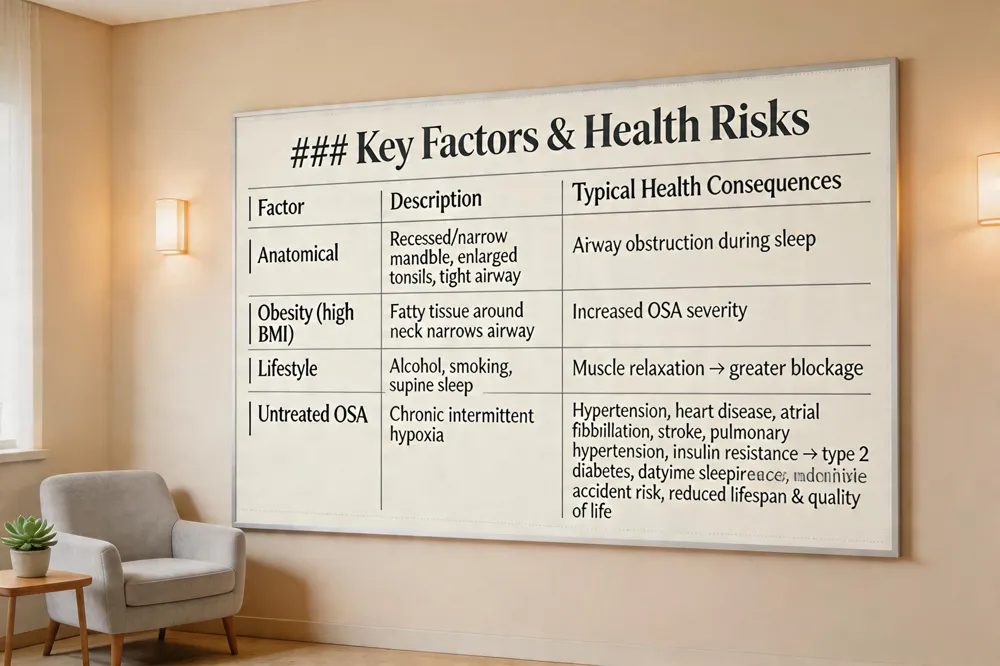 Obstructive sleep apnea (OSA) is characterized by repeated collapse of the upper airway during sleep, which interrupts breathing and lowers blood‑oxygen levels. Anatomical contributors include a recessed or narrow mandible, enlarged tonsils, and a naturally tight airway, while excess body‑mass index adds fatty tissue around the neck that narrows the passage. Lifestyle factors such as alcohol consumption, smoking, and supine sleeping further relax throat muscles and exacerbate airway blockage. Untreated OSA carries serious health risks: chronic intermittent hypoxia drives hypertension, increases the likelihood of heart disease, atrial fibrillation, stroke, and pulmonary hypertension, and promotes insulin resistance leading to type 2 diabetes. Sleep fragmentation produces excessive daytime sleepiness, impaired cognition, mood disturbances, and a higher incidence of motor‑vehicle accidents. Over time, these cardiovascular, metabolic, and neurocognitive impacts can shorten lifespan and markedly reduce quality of life.
Treatment Landscape: CPAP vs. Oral Appliances
CPAP vs. Oral Appliance Therapy (OAT) Comparison
| Metric | CPAP | Oral Appliance (MAD) |
|---|---|---|
| Primary efficacy (AHI reduction) | 80‑90 % (gold‑standard) | 30‑60 % reduction |
| Typical adherence | 30‑50 % abandon therapy; 40‑60 % meet ≥4 h/night | 70‑80 % nightly use (up to 80 % of nights) |
| Comfort & lifestyle | Mask discomfort, noise, claustrophobia | Quiet, portable, mask‑free |
| Best suited for | Moderate‑to‑severe OSA, BMI > 35 kg/m², anatomical mask issues | Mild‑to‑moderate OSA, BMI < 35 kg/m², patient preference |
| Adjunctive strategies | Positional therapy, weight loss, nasal optimization | Same as CPAP; can be combined for severe OSA |
| Real‑world health benefit | Highest AHI reduction, but limited by adherence | Comparable daytime sleepiness and QoL improvements when adherent |
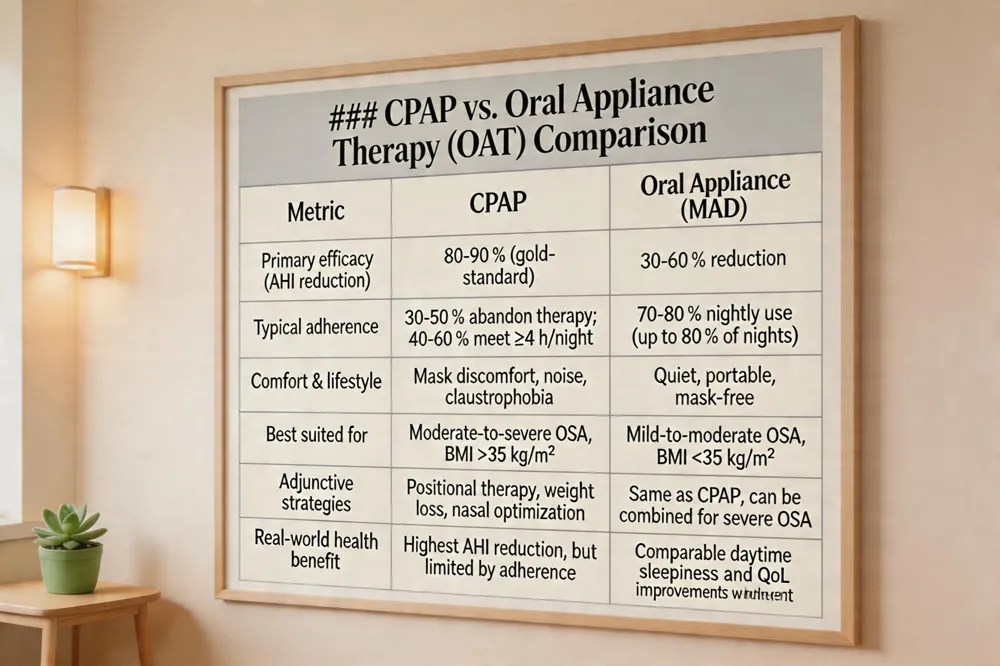 Continuous positive airway pressure (CPAP) remains the gold‑standard for moderate‑to‑severe obstructive sleep apnea because it lowers the apnea‑hypopnea index (AHI) by 80‑90 % when used consistently. However, adherence is poor, with 30‑50 % of patients abandoning therapy due to mask discomfort, noise, or claustrophobia. Oral appliance therapy (OAT) using custom mandibular advancement splints is less potent at reducing AHI (30‑60 % reduction) but yields comparable improvements in daytime sleepiness, quality‑of‑life scores (Epworth, FOSQ, SF‑36) because adherence is markedly higher (up to 80 % of nights). Studies show no statistical difference in successful treatment rates between CPAP and oral appliances for non‑severe OSA and even a trend toward better outcomes with appliances in severe OSA when CPAP is poorly tolerated. When a CPAP mask cannot be used—whether because of anatomical issues, severe mask irritation, or patient preference—an oral appliance offers a viable, FDA‑cleared alternative, especially for mild‑to‑moderate OSA or for patients with a BMI < 35 kg/m². Complementary strategies such as positional therapy, weight loss, and nasal airway optimization can further enhance results. In short, while CPAP delivers the greatest AHI reduction, oral appliances often achieve similar real‑world health benefits thanks to superior comfort and adherence, making them an essential option when CPAP is not tolerated.
Tigani Family Dentistry’s Sleep‑Dentistry Services
Services Offered by Tigani Family Dentistry
| Service | Details |
|---|---|
| Custom mandibular advancement devices | On‑site lab fabrication; patient‑specific fit; rapid turnaround |
| Lifestyle counseling | Weight management, sleep position, alcohol use, smoking cessation |
| Diagnostic coordination | Referral for polysomnography or home sleep testing; assistance with paperwork |
| CPAP & advanced therapy referrals | When needed, patients are referred to qualified sleep‑medicine specialists |
| Scheduling | Call (302) 571‑8740, online portal ("Take‑home sleep studies" or "Sleep Dentistry & Snoring Treatments"), or in‑person visit at 4600 New Linden Rd, Suite 202, Wilmington, DE |
| Integrated care | Dental expertise combined with coordinated medical follow‑up for comprehensive sleep‑management |
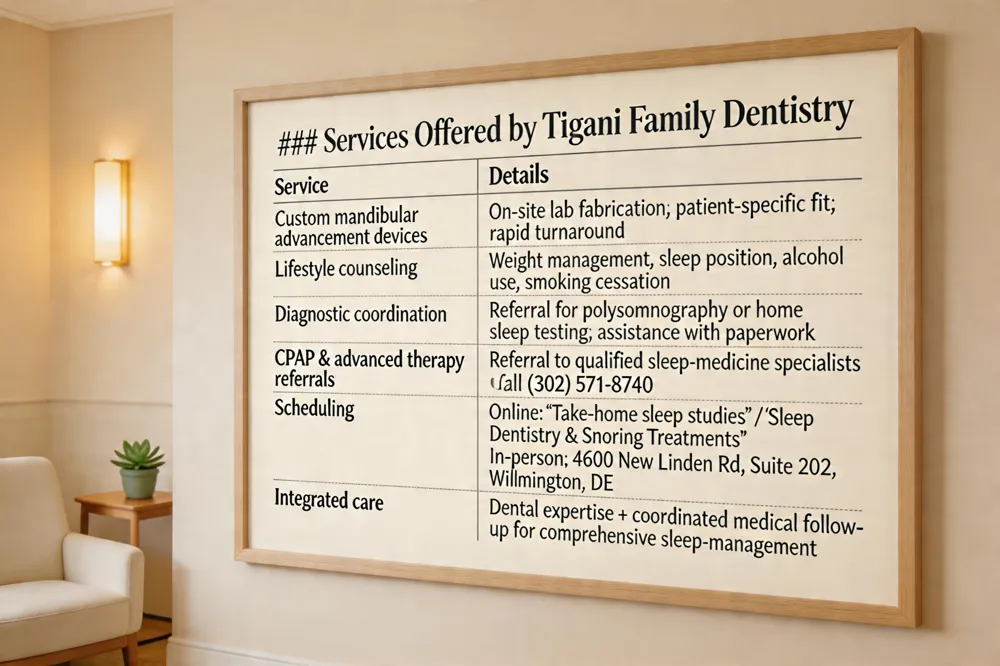 Tigai Family Dentistry in Wilmington, DE treats obstructive sleep apnea primarily with custom‑fabricated mandibular advancement devices (mandibular advancement devices (MADs)). Using an on‑site laboratory, the practice creates precise, patient‑specific oral appliances that gently reposition the lower jaw to keep the airway open, delivering faster turnaround and easy adjustments. In addition to appliance therapy, the team provides lifestyle counseling that addresses weight management, sleep position, alcohol use, and other factors that can worsen apnea. When a patient’s condition warrants more extensive testing, Tigani promptly refers them to a qualified sleep‑medicine specialist for diagnostic polysomnography or home sleep testing and possible CPAP or advanced therapies. Scheduling a sleep‑apnea evaluation is simple: patients can call (302) 571‑8740, use the online booking portal selecting “Take‑home sleep studies” or “Sleep Dentistry & Snoring Treatments,” or visit the office at 4600 New Linden Rd, Suite 202, Wilmington, DE during regular office hours. The comprehensive, family‑focused approach blends dental expertise with coordinated medical care to deliver effective, comfortable,‑management options.
Mechanics of Mandibular Advancement Devices
MAD vs. TSD Overview
| Device Type | Mechanism | Fitting Process | Short‑Term Side Effects | Long‑Term Considerations |
|---|---|---|---|---|
| Mandibular Advancement Device (MAD) | Pulls lower jaw forward, enlarges airway | Dental impression or 3‑D scan → lab fabrication → titration visits (2‑4 weeks) | Increased salivation, dry mouth, mild jaw discomfort | Bite changes, tooth movement, TMJ irritation if ill‑fitted |
| Tongue‑Stabilizing Device (TSD) | Suction bulb holds tongue ahead of palate | Similar impression/scan; device holds tongue without dental support | Similar oral discomfort; possible tongue soreness | Less impact on dental structures; may be less effective if tongue size large |
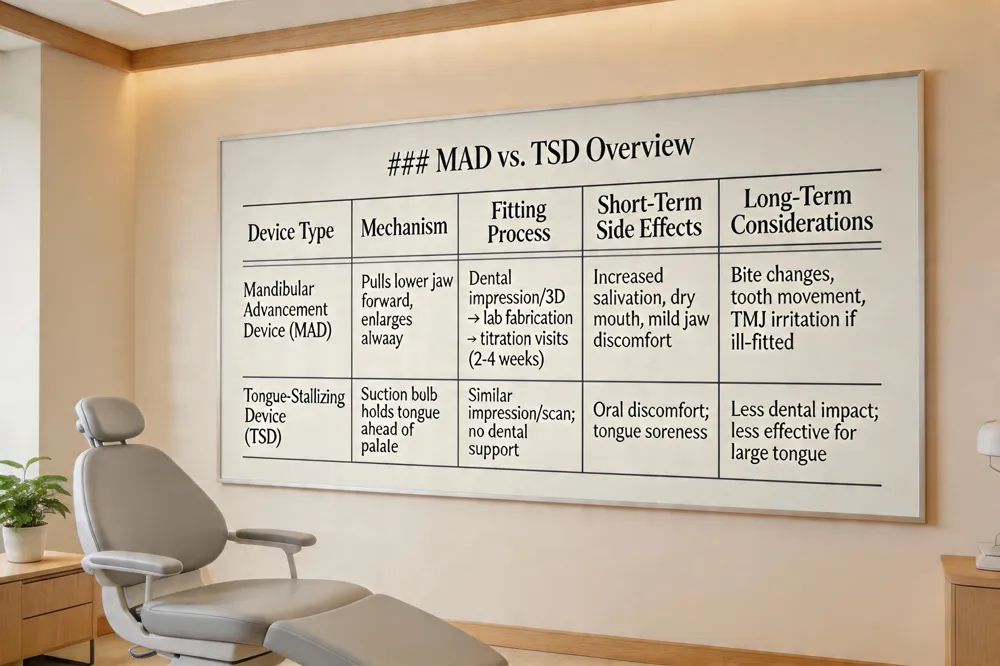 Mandibular advancement devices (MADs) and tongue‑stabilizing devices (TSDs) are the two principal oral appliances for obstructive sleep apnea. MADs are custom‑made mouthpieces that pull the lower jaw forward, enlarging the airway; TSDs use a suction bulb to hold the tongue ahead of the palate when dental support is limited. The fitting process begins with a dental impression or 3‑D scan, followed by laboratory fabrication of a precise, retainer‑like device. After delivery, patients wear the appliance for two to four weeks, gradually increasing nightly use while the dentist makes small titrations to achieve optimal mandibular protrusion and comfort. Short‑term side effects may include increased salivation, dry mouth, or mild jaw discomfort; long‑term issues can involve bite changes, tooth movement, or TMJ irritation if the device is ill‑fitted.
How does an oral appliance for sleep apnea work? The device gently advances the lower jaw forward, keeping the airway open during sleep and reducing apnea events.
The two main types of oral appliances are mandibular advancement devices (MADs) and tongue‑stabilizing devices (TSDs)
Financial Aspects: Costs and Insurance
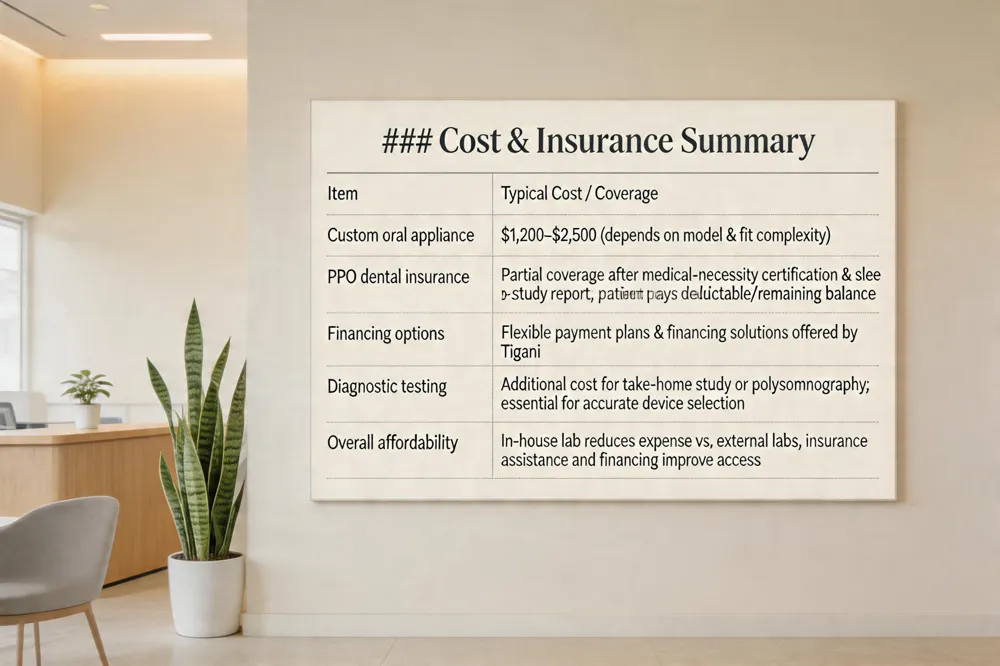
Cost & Insurance Summary
| Item | Typical Cost / Coverage |
|---|---|
| Custom oral appliance | $1,200 – $2,500 (depends on model & fit complexity) |
| PPO dental insurance | Partial coverage after medical‑necessity certification & sleep‑study report; patient pays deductible/remaining balance |
| Financing options | Flexible payment plans & financing solutions offered by Tigani |
| Diagnostic testing | Additional cost for take‑home study or polysomnography; essential for accurate device selection and may reduce future adjustments |
| Overall affordability | In‑house lab reduces expense vs. external labs; insurance assistance and financing improve access |
 Price Range for Custom Oral Appliances
At Tigani Family Dentistry, custom‑made oral appliances for sleep apnea typically cost between $1,200 – $2,500. The exact price depends on the device model (e.g., DNA, mRNA, VIVOS) and the complexity of the fit. In‑house laboratory fabrication helps keep expenses lower than outsourcing to external labs.
PPO Insurance Coverage and Documentation
Most PPO dental plans will cover a portion of a sleep‑apnea oral appliance, but coverage is not automatic. Insurers usually require a medical‑necessity certification from the dentist and a sleep‑study report. Once prior authorization is granted, the plan pays a percentage of the device cost, leaving the patient responsible for any deductible or remaining balance. Coverage levels vary by carrier, so verifying policy details before treatment is essential.
Financing Options and Payment Plans
For patients lacking full insurance reimbursement, Tigani offers financing solutions and flexible payment plans to spread the cost over time. These options make the therapy more affordable without delaying treatment.
Impact of Diagnostics on Overall Cost
Diagnostic testing, such as a take‑home sleep study or polysomnography, adds to the total expense. However, accurate diagnosis ensures appropriate appliance selection and can reduce the need for future adjustments, ultimately saving money. Tigani assists patients in coordinating diagnostics and insurance paperwork to maximize reimbursement and streamline care.
Adherence, Lifestyle, and Long‑Term Health Outcomes
Adherence & Outcome Highlights
| Factor | CPAP | Oral Appliance |
|---|---|---|
| Adherence (≥4 h/night) | 40‑60 % of patients | 70‑80 % of patients |
| Impact of BMI | >35 kg/m² reduces suitability for MAD; weight loss improves both therapies | >35 kg/m² generally poor candidate for MAD; weight loss improves efficacy |
| Cardiovascular benefits | Blood‑pressure control, endothelial function when adherent | Comparable benefits in adherent users |
| Quality‑of‑Life gains | Improved Epworth Sleepiness Scale, SF‑36 scores | Similar improvements when used consistently |
| Lifestyle synergy | Weight loss, positional therapy enhance effect | Same synergistic effects; combined with weight management yields best outcomes |
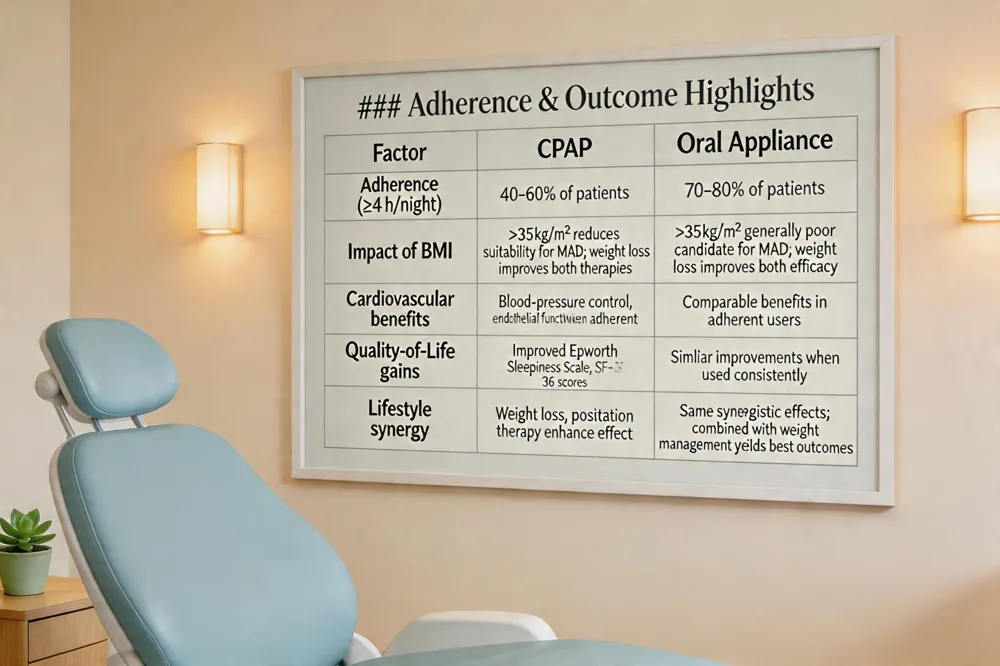 Adherence is a decisive factor in real‑world effectiveness. While CPAP reduces the apnea‑hypopnea index (AHI) by 80‑90 % when used, only about 40‑60 % of patients meet the recommended 4‑hour/night threshold; oral appliances achieve higher nightly use, with adherence rates of 70‑80 % because they are quieter, portable, and mask‑free. BMI strongly influences success: patients with a BMI >35 kg/m² are generally poor candidates for mandibular advancement splints, whereas weight loss improves both CPAP and appliance efficacy and can lower AHI by roughly 7 % per 7‑pound reduction. Patient preference and shared decision‑making improve compliance—studies show individuals who receive their chosen therapy (CPAP or oral appliance) are more likely to use it consistently. Despite CPAP’s superior AHI reduction, long‑term data reveal comparable cardiovascular benefits (blood‑pressure control, endothelial function) and quality‑of‑life gains (Epworth Sleepiness Scale, SF‑36) for adherent oral‑appliance users, especially when combined with lifestyle measures such as weight management and positional therapy.
Choosing the Right Path: Shared Decision‑Making
Decision‑Making Criteria
| Consideration | CPAP | Oral Appliance |
|---|---|---|
| Apnea severity (AHI) | Preferred for AHI ≥ 15 (moderate‑to‑severe) | Best for mild‑moderate OSA; can be adjunct in severe cases |
| BMI | >35 kg/m² favors CPAP | <35 kg/m² favorable for MAD |
| Dental anatomy | Not a factor | Requires adequate dentition & mandibular structure |
| Patient preference | Mask tolerance, noise concerns | Comfort, portability, mask‑free |
| Expected adherence | May be lower due to discomfort | Higher due to ease of use |
| Combined therapy | May add oral appliance to lower CPAP pressure | Can be added to CPAP for severe OSA |
| n | Shared decision process | Review risks/benefits, use preference‑diagnosis tools, schedule follow‑ups |
 Evaluating apnea severity and anatomy
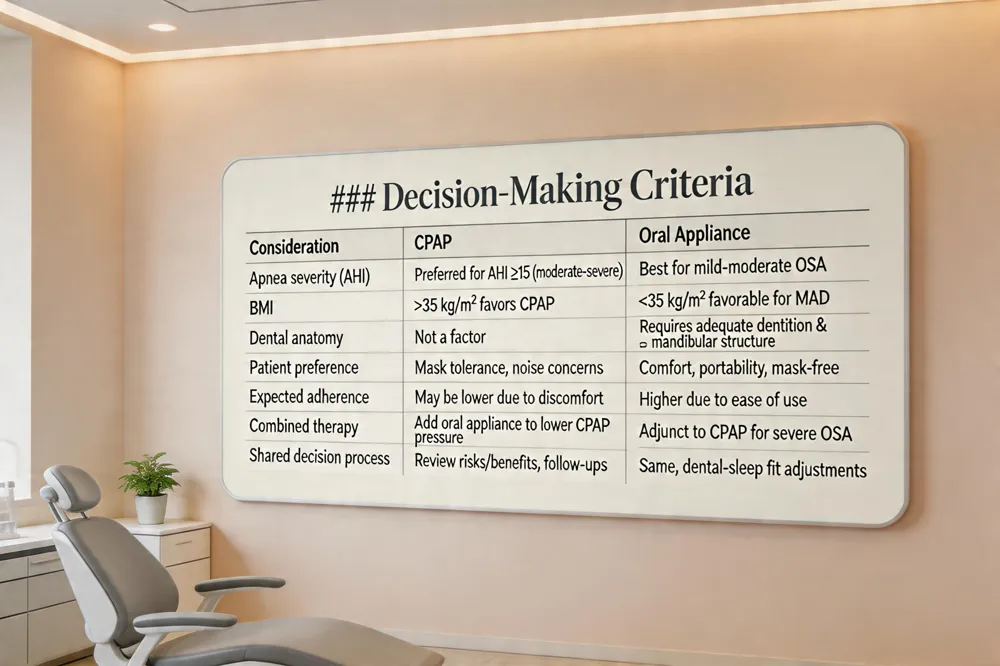
Clinicians first assess the apnea‑hypopnea index (AHI) and body‑mass index (BMI). CPAP remains the gold‑standard for moderate‑to‑severe OSA (AHI ≥ 15) and for patients with BMI > 35 kg/m², whereas mandibular advancement devices (MADs) are most effective for mild‑moderate OSA and patients with favorable dental anatomy.
Evaluating apnea severity and anatomy
Clinicians first assess the apnea‑hypopnea index (AHI) and body‑mass index (BMI). CPAP remains the gold‑standard for moderate‑to‑severe OSA (AHI ≥ 15) and for patients with BMI > 35 kg/m², whereas mandibular advancement devices (MADs) are most effective for mild‑moderate OSA and patients with favorable dental anatomy.
Balancing efficacy, comfort, and lifestyle While CPAP reduces AHI by 80‑90 %, adherence is often 30‑50 % due to mask discomfort and noise. Oral appliances achieve lower AHI reductions (30‑60 %) but boast higher adherence (≈70‑80 %) because they are quiet, portable, and mask‑free. Matching treatment to a patient’s comfort preferences typically improves real‑world effectiveness.
Combining therapies (e.g., CPAP with oral appliance) For severe OSA or when CPAP pressure requirements are high, a custom oral appliance can be added to lower the needed pressure, enhancing comfort while preserving therapeutic benefit.
Family‑focused, personalized care A shared‑decision‑making model involves the patient (and family) reviewing risks, benefits, and lifestyle impacts. Preference‑diagnosis tools increase adherence, and regular dental‑sleep follow‑ups ensure optimal fit, monitor oral health, and adjust therapy as needed.
Putting It All Together
Review CPAP, oral appliances, choose based on severity, schedule evaluation, and receive family‑focused support with expert guidance.